
N2014 PMTs -
Photomultiplier Tubes (Analog to CR332/R1924)
N2014 Photomultiplier Tubes (PMTs) are designed to replace the CR332/R1924 models. N2014 PMTs should be evaluated for low-light detection projects by comparing spectral response, gain, dark current, operating voltage, package, and divider-circuit requirements.
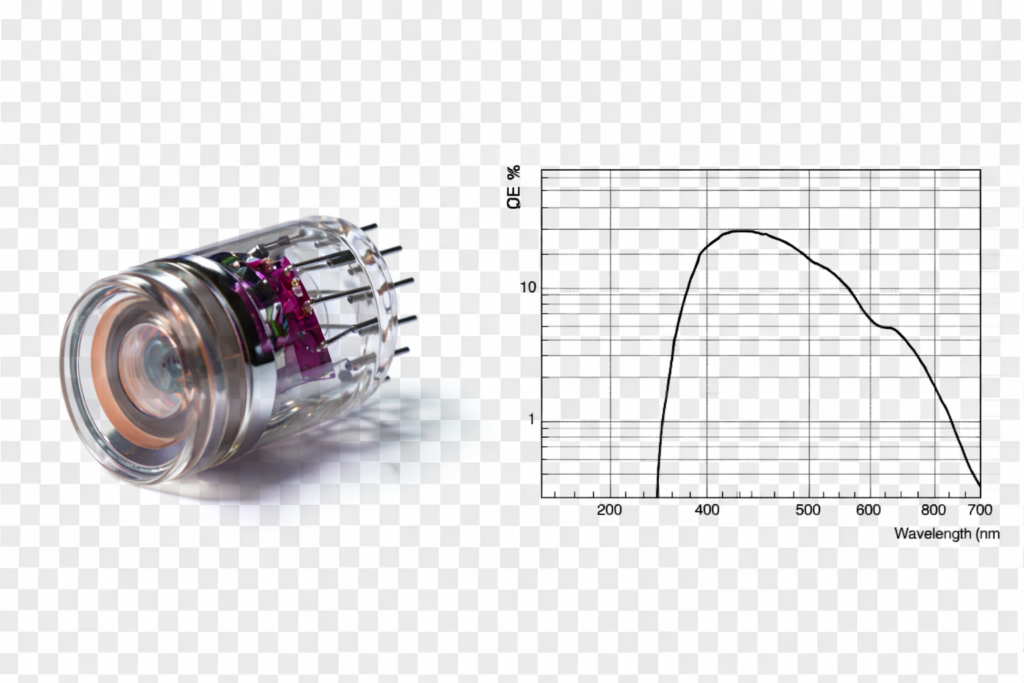
Technical Specifications
| N2014 PMTs | Min. | Typ. | Max. | Unit | |
|---|---|---|---|---|---|
| Window material | Borosilicate glass | ||||
| Photocathode material | Biakali | ||||
| Dynode structure | Circular and linear focused | ||||
| Cathode effective diameter | 22 | mm | |||
| Spectral response range | 290–650 | nm | |||
| Quantum efficiency peak wavelength | 380 | nm | |||
| Luminous sensitivity | 60 | µ A/lm | |||
| Blue sensitivity | 8 | µ A/lm | |||
| Anode blue sensitivity | 30 | A/lmf | |||
| Supply voltage | 1150 | V | |||
| Gain | 7 × 10⁶ | — | |||
| Anode dark current | N2014-1 (at 1000V) | 3 | nA | ||
| N2014-2 (at 1050V) | 5 | nA | |||
| N2014-3 (at 1100V) | 5 | nA | |||
| Dark count rate | N2014-1 | 100 | Hz | ||
| N2014-2 | 500 | Hz | |||
| Rise time | 1.2 | ns | |||
| Transit time spread (TTS) | 1.5 | ns | |||
| Operating ambient temperature | –30 to +50 | °C | |||
| Storage temperature | –50 to +50 | °C | |||
Industrial and Research Applications
FAQ – N2014 Photomultiplier Tubes
A: N2014 can be evaluated as an alternative to CR332 and R1924. Compare optical, electrical and mechanical specifications and complete sample testing in the target instrument.
A: N2014 PMTs can be reviewed for industrial, research, and medical-instrument applications requiring defined low-light detection performance, including measurement systems, imaging, and spectroscopy.
A: Compatibility depends on the base or socket, voltage-divider circuit, supply conditions, dimensions and required detector performance. Review these items before integration.
A: The N2014 PMTs offer a typical gain of 7 x 10⁶, ensuring excellent performance in low-light conditions.
A: Provide us with the details of your target application, including your desired sensitivity levels and system requirements. We will help you select the most suitable model for your needs.
Related PMT Resources
Contact Us
For more information or to request a quote, please feel free to contact us directly. We’re happy to assist with product selection and provide additional details about our PMT solutions.
N2014 PMTs Engineering Review
Concise selection notes for engineers, buyers, and maintenance teams before sampling or replacement review.
The N2014 PMTs page is intended for engineers comparing photomultiplier tube options, equivalent models, detection sensitivity, package constraints, and replacement feasibility in industrial or scientific instruments.
For N2014 PMTs, review the original tube model, spectral response, gain requirements, socket or base configuration, power supply conditions, dark current expectations, and mechanical envelope before selecting an alternative.
Related resources include PMT applications, technical documents, and engineering support.
What should engineers compare for N2014 PMTs?
Compare spectral response, gain, package type, socket configuration, operating voltage, and application conditions before selecting N2014 PMTs.
Can Sartec support PMT equivalent selection?
Yes. Sartec Photoelectronics can review original model numbers and target parameters for photomultiplier tube equivalent projects.
Is model matching enough for PMT replacement?
No. The electrical circuit, mechanical fit, sensitivity requirement, and operating environment should also be checked.
PMT selection and validation resources: compare photomultiplier tube applications, review datasheets and technical documents, or request an engineering compatibility review.
- Request a Quote
- Contact Us on WhatsApp